-
-
-
59, Diamond Harbour Road, Kolkata-700023
Welcome to Debtkart
Mon - Friday: 10.30am - 07:00pm
Credit repair refers to the process of identifying, addressing, and rectifying inaccuracies or adverse entries in an individual’s credit profile to improve their creditworthiness. It involves reviewing credit reports, disputing incorrect or unverifiable information, negotiating with lenders for settlements or restructuring, and ensuring proper reporting of resolved accounts. In practical terms, credit repair also includes correcting delayed payment records, resolving written-off or settled accounts, and ensuring compliance with regulatory guidelines such as those issued by the Reserve Bank of India (RBI) on fair credit reporting. The objective is not merely score improvement, but restoration of a borrower’s financial credibility, enabling future access to loans, credit cards, and financial products on more favorable terms.
Inaccurate or delayed data correction
Credit bureaus rely on lenders for updates. Even after settlement or repayment, lenders often delay or fail to update records, prolonging negative reporting.
Resistance from lenders
Banks and NBFCs may refuse to modify or remove adverse entries (e.g., “written-off” or “settled”), even when disputes are valid, limiting the scope of credit clean-up.
Impact of “settled” or “written-off” status
Even after resolution, such remarks continue to negatively affect the CIBIL score and future loan eligibility, making full recovery of credit profile time-consuming.
Lack of borrower awareness
Many borrowers are unaware of their rights to dispute incorrect entries or the process of credit report correction, leading to prolonged inaccuracies.
Multiple loan accounts and data mismatch
In cases of multiple lenders, inconsistencies across accounts (amounts, status, dates) create complexity in achieving a clean and uniform credit profile.
Time lag in CIBIL score improvement
Even after corrections, the credit score does not improve immediately. It requires consistent positive credit behavior over time.
Digital lending and NBFC reporting issues
Unregulated or loosely regulated digital lenders often report inconsistently or inaccurately, complicating the repair process.
Documentation and follow-up burden
Credit repair requires continuous follow-ups, submission of proof, and tracking of disputes, which can be resource-intensive.
Limited scope of removal of genuine defaults
If a default is legitimate, it cannot be erased—only mitigated through settlement or closure, which still leaves a footprint on the credit history.
Regulatory and procedural gaps
Despite RBI guidelines, enforcement gaps and lack of strict timelines for correction often work against borrowers seeking timely credit clean-up.
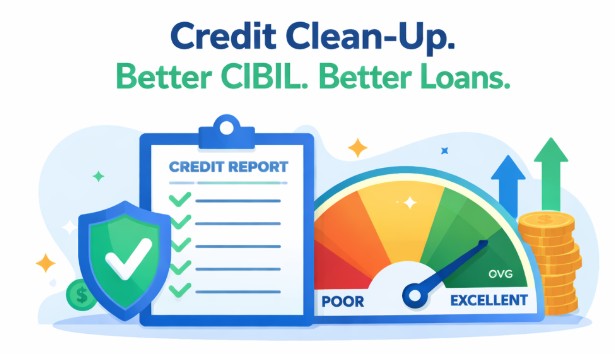
Bad credit can be effectively resolved through a structured and legally guided approach with Debtkart. The process begins with a detailed review of the borrower’s credit report to identify errors, overdue accounts, and negative entries impacting the CIBIL score.
Debtkart then initiates legal communication with lenders to stop coercive recovery practices and negotiate structured settlements such as One-Time Settlements (OTS) or revised repayment terms. At the same time, discrepancies in credit reporting are challenged and corrected to ensure accurate reflection of the borrower’s financial status.
Once liabilities are resolved and records are updated, the credit profile gradually improves, leading to a better CIBIL score and significantly enhancing the chances of obtaining loans or credit facilities in the future.
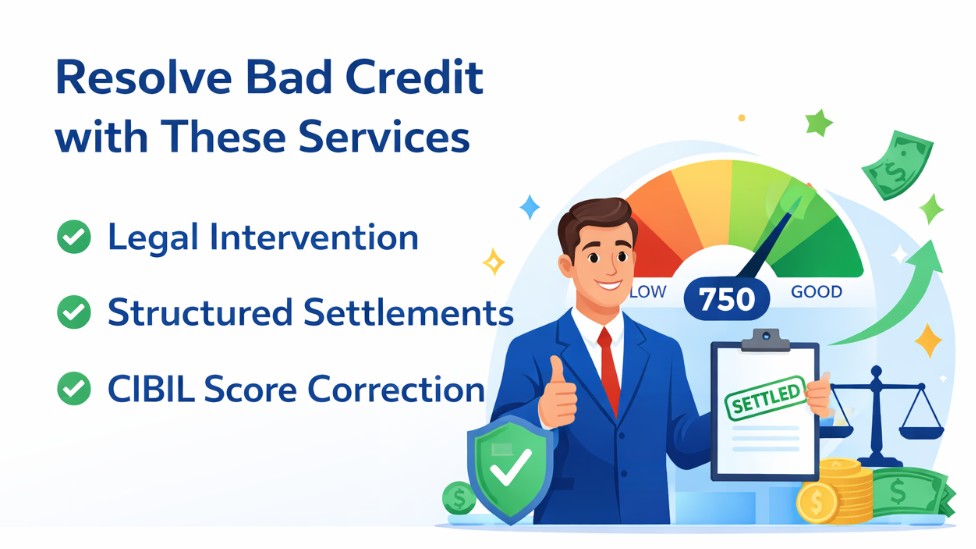
Legal intervention to protect borrower rights
Structured settlements to reduce outstanding burden
Correction of credit report and CIBIL errors
Gradual improvement in score and loan eligibility